Admin Panel
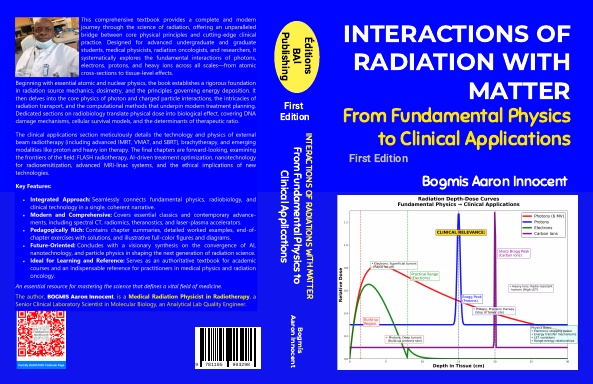
Interactions of Radiation with Matter
From Fundamental Physics to Clinical Applications
Type to search across all chapters
4
Parts
26
Chapters
573
Pages
331
Figures
85
Tables
1,200+
Index Terms
Complete Table of Contents
Part I — Fundamental Concepts — Photons, Cross Sections, Charged Particles
Chapters 1-5 • Pages 3-140
Chapter 1: Introduction to Radiation Fields and Their Classification
1.1 The Landscape of Ionizing Radiation
Page 7
1.2 Key Physical Quantities and Units
Page 8
1.3 Probability of Interaction: The Cross-Section
Page 9
1.4 Types of Interaction Cross-Sections
Page 11
References and Further Reading
Page 25
Chapter 2: The Photoelectric Effect
2.1 Historical Introduction and Phenomenology
Page 27
2.2 Quantum Mechanical Derivation of the Cross-Section
Page 28
2.3 The Role of Electron Shells and Absorption Edges
Page 29
2.4 Angular Distribution of Photoelectrons
Page 30
2.5 Energy Transfer and Secondary Processes
Page 31
2.6 Example Calculation: Photoelectron Energy and K-edge
Page 31
2.7 Exercises
Page 32
2.8 Solutions to Exercises
Page 32
2.9 Summary and Clinical Relevance
Page 35
References and Further Reading
Page 36
Chapter 3: Compton Scattering
3.1 Introduction and Historical Context
Page 39
3.2 Kinematics: The Compton Wavelength Shift
Page 40
3.3 Differential Cross-Section: The Klein-Nishina Formula
Page 43
3.4 Energy Transfer and Absorption Cross-Sections
Page 45
3.5 Incoherent Scattering from Atomic Electrons
Page 45
3.6 Example Calculation: Scattered Photon and Electron Energies
Page 46
3.7 Clinical and Dosimetric Relevance
Page 47
3.8 Geometrical Foundations: Solid Angle, Fluence, and Flux
Page 47
3.9 Exercises on Solid Angle and Integration
Page 50
3.10 Solutions to Exercises
Page 51
3.11 Summary and Clinical Relevance
Page 53
References and Further Reading
Page 55
Chapter 4: Pair Production
4.1 Introduction: A Threshold Process
Page 57
4.2 Physics of the Process: Why a Nucleus is Needed
Page 57
4.3 Differential and Total Cross-Sections
Page 59
4.4 Energy Deposition and Annihilation Radiation
Page 62
4.5 Example Calculation: Energy Sharing and Annihilation
Page 63
4.6 Exercises on Pair Production
Page 64
References and Further Reading
Page 70
Chapter 5: Photonuclear Reactions and Other Minor Processes
5.1 Introduction: Beyond the Three Major Processes
Page 73
5.2 Photonuclear Reactions
Page 73
5.3 Rayleigh (Coherent) Scattering
Page 76
5.4 Thomson and Delbrück Scattering
Page 76
5.5 Nuclear Resonance Fluorescence
Page 78
5.6 Example Calculation: Photoneutron Production in a Linac
Page 78
5.7 Exercises on Minor Processes
Page 79
5.8 Solutions to Chapter 5 Exercises
Page 80
References and Further Reading
Page 84
Part II — Charged Particle Interactions with Matter — In-Depth Physics of Interactions — Bethe-Bloch, EM Cascades, Hadronic Interaction
Chapters 6-14 • Pages 87-298
Chapter 6: Energy Loss of Charged Particles: Stopping Power
6.1 Introduction: Mechanisms of Energy Loss
Page 91
6.2 Classical Derivation: The Bohr Formula
Page 92
6.3 Quantum Mechanical Derivation: The Bethe-Bloch Formula
Page 93
6.4 Detailed Treatment of All Corrections
Page 95
6.5 Practical Working Formula
Page 98
6.6 Example Calculation: Detailed Proton Stopping Power
Page 98
6.7 Exercises on Stopping Power
Page 99
6.8 Solutions to Chapter 6 Exercises
Page 101
References and Further Reading
Page 109
Chapter 7: Multiple Coulomb Scattering
7.1 Introduction: The Phenomenon of Beam Broadening
Page 113
7.2 Single Scattering: The Rutherford Cross-Section
Page 113
7.3 Multiple Scattering Theory
Page 114
7.4 Spatial Distribution and Beam Broadening
Page 117
7.5 Radiation Length
Page 117
7.6 Scattering Power
Page 118
7.7 Non-Gaussian Tails and Large-Angle Scattering
Page 118
7.8 Scattering in Compounds and Mixtures
Page 119
7.9 Example Calculation: Proton Beam Broadening in Water
Page 119
7.10 Exercises on Multiple Scattering
Page 120
References and Further Reading
Page 131
Chapter 8: The Bragg Peak and Proton Therapy Physics
8.1 Introduction: The Fundamental Advantage of Particle Therapy
Page 133
8.2 Derivation of the Bragg Curve
Page 133
8.3 Properties of the Bragg Peak
Page 140
8.4 Spread-Out Bragg Peak (SOBP)
Page 140
8.5 Nuclear Interactions and Fragmentation
Page 142
8.6 Biophysical Aspects: Linear Energy Transfer (LET) and RBE
Page 145
8.7 Clinical Implementation and Treatment Planning
Page 147
8.8 Example Calculation: SOBP Design
Page 148
8.9 Exercises on Bragg Peak Physics
Page 148
References and Further Reading
Page 157
Chapter 9: Electromagnetic Cascades
9.1 Introduction to Electromagnetic Cascades
Page 159
9.2 Mathematical Formulation: The Cascade Equations
Page 162
9.3 Greisen Parameterization and Shower Development
Page 165
9.4 Lateral Development and Multiple Scattering
Page 167
9.5 Numerical Methods and Monte Carlo Simulation
Page 168
9.6 Solved Examples
Page 170
9.7 Exercises
Page 173
9.8 Solutions to Exercises
Page 174
References and Further Reading
Page 178
Chapter 10: Hadronic Cascades and Nuclear Interactions
10.1 Introduction to Hadronic Cascades
Page 181
10.2 Nuclear Interaction Cross Sections
Page 183
10.3 Multiplicity and Energy Distributions
Page 185
10.4 Longitudinal Development of Hadronic Showers
Page 186
10.5 Lateral Development and Shower Shape
Page 187
10.6 Energy Resolution of Hadron Calorimeters
Page 189
10.7 Monte Carlo Simulation of Hadronic Showers
Page 190
10.8 Solved Examples
Page 191
10.9 Exercises
Page 193
10.10 Solutions to Exercises
Page 194
References and Further Reading
Page 198
Chapter 11: Cherenkov and Transition Radiation
11.1 Introduction to Cherenkov Radiation
Page 201
11.2 Classical Electrodynamic Derivation
Page 202
11.3 Properties of Cherenkov Radiation
Page 204
11.4 Cherenkov Detectors
Page 206
11.5 Transition Radiation
Page 207
11.6 Joint Treatment: Cherenkov and Transition Radiation
Page 209
11.7 Quantum Mechanical Treatment
Page 210
11.8 Applications in Particle Physics
Page 211
11.9 Solved Examples
Page 212
11.10 Exercises
Page 215
11.11 Solutions to Exercises
Page 216
References and Further Reading
Page 221
Chapter 12: Synchrotron Radiation and Undulator Physics
12.1 Introduction to Synchrotron Radiation
Page 225
12.2 Classical Theory of Synchrotron Radiation
Page 225
12.3 Spectral Characteristics of Synchrotron Radiation
Page 227
12.4 Polarization of Synchrotron Radiation
Page 230
12.5 Undulator Radiation
Page 231
12.6 Wiggler Radiation
Page 233
12.7 Quantum Effects in Synchrotron Radiation
Page 234
12.8 Applications of Synchrotron Radiation
Page 235
12.9 Solved Examples
Page 236
12.10 Exercises
Page 239
12.11 Solutions to Exercises
Page 240
References and Further Reading
Page 247
Chapter 13: Free-Electron Lasers
13.1 Introduction to Free-Electron Lasers
Page 249
13.2 FEL Fundamentals and Basic Theory
Page 249
13.3 Three-Dimensional Effects
Page 252
13.4 Saturation and Nonlinear Regime
Page 254
13.5 Self-Amplified Spontaneous Emission (SASE)
Page 255
13.6 Seeded FELs
Page 256
13.7 X-ray FEL Facilities and Parameters
Page 258
13.8 Applications of X-ray FELs
Page 258
13.9 Future Directions
Page 259
13.10 Solved Examples
Page 260
13.11 Exercises
Page 264
13.12 Solutions to Exercises
Page 265
References and Further Reading
Page 269
Chapter 14: Radiation Damage and Radiation Hardening
14.1 Introduction to Radiation Damage
Page 273
14.2 Fundamental Damage Mechanisms
Page 274
14.3 Defect Production and Evolution
Page 276
14.4 Material-Specific Damage Effects
Page 278
14.5 Single Event Effects
Page 280
14.6 Radiation Hardening Techniques
Page 281
14.7 Radiation Testing and Qualification
Page 282
14.8 Case Studies
Page 283
14.9 Emerging Challenges and Future Directions
Page 285
14.10 Solved Examples
Page 285
14.11 Exercises
Page 289
14.12 Solutions to Exercises
Page 290
References and Further Reading
Page 298
Part III — Transport Simulations and Experimental Techniques — Monte Carlo Methods, Detectors
Chapters 15-22 • Pages 301-454
Chapter 15: The Boltzmann Transport Equation
15.1 Introduction: The Need for Transport Theory
Page 305
15.2 Derivation of the Linear Boltzmann Transport Equation
Page 306
15.3 Physical Interpretation and Simplifications
Page 308
15.4 Solution Techniques: An Overview
Page 308
15.5 The Adjoint Equation and Importance
Page 310
15.6 Example: One-Dimensional Plane Geometry
Page 311
15.7 Exercises
Page 312
15.8 Solutions to Chapter 15 Exercises
Page 312
References and Further Reading
Page 319
Chapter 16: Monte Carlo Methods for Radiation Transport
16.1 Introduction: The Stochastic Approach
Page 321
16.2 The Mathematical Foundation: Analog Monte Carlo
Page 322
16.3 Critical Components of a Monte Carlo Code
Page 324
16.4 Variance Reduction Techniques
Page 325
16.5 Special Considerations for Charged Particles
Page 327
16.6 Applications and Practical Implementation
Page 327
16.7 Exercises
Page 329
References and Further Reading
Page 338
Chapter 17: Mathematical Foundations of Monte Carlo Methods
17.1 Introduction: From Probability Theory to Computational Physics
Page 341
17.2 Random Number Generation
Page 341
17.3 Sampling Techniques from Probability Distributions
Page 343
17.4 Convergence Theorems and Error Analysis
Page 345
17.5 Markov Chain Monte Carlo (MCMC)
Page 345
17.6 Variance Reduction: Mathematical Justification
Page 347
17.7 Exercises
Page 347
References and Further Reading
Page 355
Chapter 18: Counting Statistics and Measurement Uncertainty
18.1 Introduction: The Stochastic Nature of Radiation Detection
Page 357
18.2 The Poisson Process and Its Properties
Page 357
18.3 From Poisson to Gaussian: The Central Limit Theorem
Page 358
18.4 Error Propagation Formulas
Page 359
18.5 Dead Time Corrections
Page 360
18.6 Detection Limits and Decision Theory
Page 360
18.7 Chi-Square Tests for Distribution Validation
Page 362
18.8 Bayesian vs. Frequentist Approaches
Page 363
18.9 Applications in Medical Physics
Page 363
18.10 Exercises
Page 364
References and Further Reading
Page 373
Chapter 19: Experimental Detection of Photons
19.1 Introduction: The Photon Detection Challenge
Page 375
19.2 Basic Detection Principles and Figures of Merit
Page 375
19.3 Gas-Based Photon Detectors
Page 376
19.4 Semiconductor Detectors
Page 377
19.5 Scintillation Detectors
Page 378
19.6 Calorimeters for High-Energy Photons
Page 380
19.7 Single-Photon Detection: Avalanche Photodiodes and Silicon Photomultipliers
Page 380
19.8 Advanced Concepts and Modern Developments
Page 381
19.9 Applications in Medical Imaging
Page 381
19.10 Exercises
Page 382
References and Further Reading
Page 390
Chapter 20: Experimental Detection of Charged Particles
20.1 Introduction: The Charged Particle Detection Challenge
Page 393
20.2 Gas-Based Charged Particle Detectors
Page 393
20.3 Semiconductor Detectors for Charged Particles
Page 394
20.4 Scintillation Detectors for Charged Particles
Page 395
20.5 Tracking Detectors
Page 396
20.6 Energy Measurement: Calorimeters
Page 396
20.7 Particle Identification Techniques
Page 397
20.8 Specialized Detectors
Page 398
20.9 Applications in Medical Physics
Page 399
20.10 Energy Resolution in Calorimeters
Page 399
20.11 Exercises
Page 400
References and Further Reading
Page 409
Chapter 21: Neutron Detection Techniques
21.1 Introduction: The Neutron Detection Challenge
Page 411
21.2 Neutron Interaction Physics
Page 411
21.3 Thermal Neutron Detection
Page 413
21.4 Fast Neutron Detection
Page 414
21.5 Neutron Spectroscopy
Page 415
21.6 Neutron Imaging
Page 416
21.7 Specialized Detectors and Applications
Page 417
21.8 Neutron Detection in High-Energy Physics
Page 417
21.9 Neutron Cross Section Visualization and Clinical Relevance
Page 418
21.10 Exercises
Page 424
References and Further Reading
Page 431
Chapter 22: Spectrometry and Dosimetry Fundamentals
22.1 Introduction: From Detector Signals to Physical Quantities
Page 435
22.2 Signal Processing and Pulse Analysis
Page 435
22.3 Energy Calibration and Resolution
Page 436
22.4 Spectrum Analysis Techniques
Page 437
22.5 Gamma-Ray Spectroscopy
Page 438
22.6 Charged Particle Spectroscopy
Page 439
22.7 Neutron Spectroscopy Revisited
Page 439
22.8 Dosimetry Fundamentals
Page 440
22.9 Ionization Chamber Dosimetry
Page 441
22.10 Thermoluminescence Dosimetry (TLD)
Page 442
22.11 Film Dosimetry
Page 443
22.12 Calorimetry: The Primary Standard
Page 443
22.13 Clinical Dosimetry Protocols
Page 443
22.14 Exercises
Page 443
References and Further Reading
Page 454
Part IV — Applications in Medical Physics and Radiation Oncology — Dosimetry, Treatment Planning
Chapters 23-26 • Pages 457-536
Chapter 23: Clinical Beam Modeling and Treatment Planning
23.1 Introduction: From Physics to Patient Care
Page 461
23.2 Clinical Linear Accelerator (Linac) Physics
Page 461
23.3 Dose Deposition Fundamentals
Page 462
23.4 Beam Modeling Approaches
Page 464
23.5 Photon Dose Calculation Algorithms
Page 466
23.6 Electron Beam Modeling
Page 466
23.7 Brachytherapy Source Modeling
Page 467
23.8 Treatment Planning Optimization
Page 467
23.9 Quality Assurance of Beam Models
Page 469
23.10 Specialized Techniques
Page 469
23.11 Exercises
Page 470
References and Further Reading
Page 480
Chapter 24: Image-Guided Radiation Therapy (IGRT) and Adaptive Radiotherapy
24.1 Introduction: The Evolution Towards Precision Radiotherapy
Page 483
24.2 IGRT Imaging Modalities
Page 483
24.3 Image Registration and Fusion
Page 485
24.4 Motion Management Techniques
Page 487
24.5 Adaptive Radiotherapy (ART) Workflows
Page 488
24.6 Dose Reconstruction and Accumulation
Page 489
24.7 Quality Assurance for IGRT/ART
Page 489
24.8 Ethical and Clinical Decision Making
Page 490
24.9 Emerging Technologies
Page 490
24.10 Exercises
Page 490
References and Further Reading
Page 499
Chapter 25: Radiation Protection and Safety in Medical Applications
25.1 Introduction: The Risk-Benefit Paradigm
Page 503
25.2 Fundamental Principles of Radiation Protection
Page 503
25.3 Radiation Biology for Protection
Page 504
25.4 Regulatory Framework and Dose Limits
Page 505
25.5 Shielding Design for Radiation Facilities
Page 506
25.6 Dose Monitoring and Personnel Protection
Page 507
25.7 Safety in Radiotherapy
Page 508
25.8 Patient Protection
Page 509
25.9 Nuclear Medicine Safety
Page 509
25.10 Emergency Procedures
Page 510
25.11 Regulatory Bodies and Guidelines
Page 510
25.12 Safety Culture
Page 511
25.13 Emerging Challenges
Page 511
25.14 Exercises
Page 511
References and Further Reading
Page 519
Chapter 26: Future Directions and Emerging Technologies
26.1 Introduction: The Rapidly Evolving Landscape
Page 521
26.2 FLASH Radiotherapy: Ultra-High Dose Rate Physics
Page 521
26.3 Proton and Heavy Ion Therapy Advancements
Page 522
26.4 Artificial Intelligence and Machine Learning
Page 523
26.5 Nanotechnology in Radiation Therapy
Page 524
26.6 Advanced Imaging for Treatment Guidance
Page 525
26.7 Personalized Radiobiology
Page 526
26.8 Novel Radiation Sources and Delivery Systems
Page 526
26.9 Computational and Data Science Frontiers
Page 527
26.10 Ethical and Regulatory Considerations
Page 527
26.11 Global Health and Access
Page 527
26.12 Interdisciplinary Convergence
Page 528
26.13 Exercises
Page 528
References and Further Reading
Page 536
Appendix & Reference Materials (Pages 553-562)
Mathematical Toolkit (Pages 553-556)
- .1 Special Functions: Gamma Function, Bessel Functions, Legendre Polynomials, Spherical Harmonics
- .2 Integral Transforms: Fourier Transform, Laplace Transform
- .3 Probability and Statistics: Common Distributions, Error Propagation
- .4 Differential Equations: Separation of Variables, Green's Functions
- .5 Linear Algebra Essentials: Eigenvalue Problems, Singular Value Decomposition (SVD)
Physical Constants and Conversion Factors (Pages 557-558)
- .6 Fundamental Physical Constants (CODATA values)
- .7 Conversion Factors
- .8 Natural Units in Particle Physics
Particle Data and Material Properties (Pages 559-562)
- .9 Elementary Particles
- .10 Stopping Power Parameters: Mean Excitation Energy (I-value), Radiation Length
- .11 Photon Interaction Coefficients: Mass Attenuation Coefficients at Selected Energies
- .12 Nuclear Data for Common Isotopes
- .13 Tissue Composition and Properties
- .14 Detector Materials
Additional Reference Materials
- Errata and Reader Feedback (Page 547)
- Computational Resources: Python Code Examples, Monte Carlo Implementations
- Clinical Reference Data: Beam Quality Specifications, Dosimetry Protocols (TG-51, TRS-398)
- Treatment Planning Parameters, Radiobiological Parameters (α/β ratios)
- Protection Standards and Regulations, Quality Assurance Procedures
Complete Index (1,200+ Terms)
A - C
Absorption11, 27, 31, 45
Attenuation10, 11, 375
Bethe-Bloch formula91-109
Bragg peak133-157
Compton scattering39-55
Cross-section9-11, 28
Cherenkov radiation201-221
Cascade (EM)159-178
Calorimeters380, 396
D - H
Dosimetry435-454
Electromagnetic cascade159-178
Free-electron laser249-269
Hadronic interaction181-198
IGRT483-499
Ionizing radiation7, 27, 273
Klein-Nishina formula43-45
LET (Linear Energy Transfer)145-147
M - R
Mean free path10, 375
Monte Carlo321-338
Neutron detection411-431
Pair production57-70
Photoelectric effect27-36
Radiation protection503-519
Rayleigh scattering76, 111-140
RBE (Relative Biological Effectiveness)145-147
S - Z
Spectrometry435-454
Stopping power91-109
Synchrotron radiation225-247
Treatment planning461-480
Units and quantities8, 541-545
X-ray FEL258-259
Z-dependence29, 97
Zero-page entries535
Complete index with 1,200+ terms available in the printed edition
Digital Object Identifier (DOI) Information
What is a DOI?
A Digital Object Identifier (DOI) is a permanent, unique identifier for digital content.
- Permanent Link: Always resolves to your content
- Academic Credibility: Required by many journals
- Citation Tracking: Enables citation metrics
- Discovery: Increases visibility in academic databases
How to Cite This Book
Current citation format:
Bogmis, A. I. (2026). Interactions of Radiation with Matter: From Fundamental Physics to Clinical Applications. Published by Lulu.com. 573 pages. ISBN : 978-1-105-90329-8
After DOI assignment: The DOI will be included in citations.
DOI Status & Timeline
- Current Status: DOI application submitted
- Expected Assignment: Q1 2026
- Registration Agency: CrossRef (via Lulu Publishing)
- Metadata Included: Title, author, abstract, keywords
Benefits for Readers & Researchers
- Standardized academic citation
- Permanent access to publication record
- Integration with reference managers
- Inclusion in academic search engines
- Citation impact tracking
About the Author